
Oscillatory problems are a class of mathematical and physical phenomena in which the solutions display periodic or quasi-periodic variations with respect to time or space. Oscillatory systems subject to external forcing are central in many physical and engineering contexts, and the presence or absence of damping critically influences their behavior. In this comparative study, we develop and evaluate wavelet-based numerical schemes for forced oscillatory differential equations, considering both damped and undamped regimes. Specifically, we employ second-kind Chebyshev wavelets and Haar wavelets, together with their operational integration matrices, to discretize and approximate the solutions of second-order forced oscillators. The wavelet formulations transform the differential problems into systems of algebraic equations, which we then solve under a variety of forcing frequencies and damping parameters. Our numerical experiments demonstrate that Chebyshev wavelets, due to their higher smoothness and spectral accuracy, are particularly effective in capturing the transient decay and subtle features of damped oscillations. In contrast, Haar wavelets provide a computationally efficient and stable approximation in undamped systems, especially in scenarios prone to resonance. We compare these methods across key metrics such as convergence rate, error behavior, and computational cost. The numerical results confirm that Chebyshev wavelets are particularly effective in capturing the fine decay dynamics of damped oscillations, while Haar wavelets deliver fast, stable approximations for undamped systems, especially under resonant forcing. These findings are supported by several computational experiments, which validate both the accuracy and efficiency of the proposed wavelet schemes. These insights offer practical guidance for selecting suitable wavelet approaches tailored to the physical damping conditions of forced oscillatory problems.
| Published in | American Journal of Applied Mathematics (Volume 13, Issue 6) |
| DOI | 10.11648/j.ajam.20251306.14 |
| Page(s) | 419-427 |
| Creative Commons |
This is an Open Access article, distributed under the terms of the Creative Commons Attribution 4.0 International License (http://creativecommons.org/licenses/by/4.0/), which permits unrestricted use, distribution and reproduction in any medium or format, provided the original work is properly cited. |
| Copyright |
Copyright © The Author(s), 2025. Published by Science Publishing Group |
Operational Matrices, Chebyshev Wavelets of the Second Kind, Haar Wavelets, Forced Oscillatory Problems, Damped and Undamped Systems
x/16 | Exact Solutions or Analytical solutions | Absolute Errors via Chebyshev Wavelets | Absolute Errors via Haar Wavelets |
|---|---|---|---|
1 | 0.0019499478 | 2.5041×10⁻⁹ | 1.5747×10⁻⁵ |
3 | 0.0173218970 | 8.2011×10⁻⁹ | 6.4225×10⁻⁵ |
5 | 0.0468682761 | 1.2870×10⁻⁸ | 1.5494×10⁻⁴ |
7 | 0.0882722750 | 1.6820×10⁻⁸ | 2.7602×10⁻⁴ |
9 | 0.1382493274 | 1.9709×10⁻⁸ | 4.1105×10⁻⁴ |
11 | 0.1927624127 | 2.1361×10⁻⁸ | 5.4069×10⁻⁴ |
13 | 0.2472875657 | 2.1749×10⁻⁸ | 6.4457×10⁻⁴ |
15 | 0.2971128604 | 2.0397×10⁻⁸ | 7.0328×10⁻⁴ |
x/16 | Exact Solutions or Analytical solutions | Absolute Errors via Chebyshev Wavelets | Absolute Errors via Haar Wavelets |
|---|---|---|---|
1 | 0.0018329397 | 2.1506×10⁻¹⁰ | 2.0639×10⁻⁴ |
3 | 0.0144319943 | 6.0044×10⁻¹⁰ | 4.4877×10⁻⁴ |
5 | 0.0347086663 | 8.1980×10⁻¹⁰ | 5.1632×10⁻⁴ |
7 | 0.0581674820 | 9.5328×10⁻¹⁰ | 4.7085×10⁻⁴ |
9 | 0.0809878651 | 1.0187×10⁻⁹ | 3.5719×10⁻⁴ |
11 | 0.1000501565 | 1.0396×10⁻⁹ | 2.0809×10⁻⁴ |
13 | 0.1129670146 | 1.0182×10⁻⁹ | 4.7622×10⁻⁵ |
15 | 0.1181071589 | 1.0377×10⁻⁹ | 1.0660×10⁻⁴ |
x/16 | Exact Solutions or Analytical solutions | Absolute Errors via Chebyshev Wavelets | Absolute Errors via Haar Wavelets |
|---|---|---|---|
1 | 0.0018736207 | 5.6272×10⁻¹¹ | 1.4052×10⁻⁴ |
3 | 0.0155279221 | 1.6385×10⁻¹⁰ | 3.3850×10⁻⁴ |
5 | 0.0397544870 | 2.3538×10⁻¹⁰ | 4.3963×10⁻⁴ |
7 | 0.0718802432 | 2.8932×10⁻¹⁰ | 4.7215×10⁻⁴ |
9 | 0.1097143363 | 3.2719×10⁻¹⁰ | 4.5771×10⁻⁴ |
11 | 0.1514717121 | 3.5163×10⁻¹⁰ | 4.1278×10⁻⁴ |
13 | 0.1957080004 | 3.6804×10⁻¹⁰ | 3.4964×10⁻⁴ |
15 | 0.2412640983 | 3.6242×10⁻¹⁰ | 2.7736×10⁻⁴ |
|
|
| [1] | Sheikhani, A. H. R., & Mashoof, M. Numerical solution of fractional differential equation by wavelets and hybrid functions. Boletim da sociedade paranaense de matemática, 2018, 36(2), 231-244. |
| [2] | Dizicheh, A. K., Ismail, F., Kajani, M. T., & Maleki, M. A Legendre wavelet spectral collocation method for solving oscillatory initial value problems. Journal of Applied Mathematics, 2013, 2013, 1-5. |
| [3] | Gupta, A. K., & Ray, S. S. Wavelet methods for solving fractional order differential equations. Mathematical Problems in Engineering, 2014, 2014. |
| [4] | Verma, A. K., Kumar, N., & Tiwari, D. Haar wavelets collocation method for a system of nonlinear singular differential equations. Engineering Computations, 2021, 38(2), 659-698. |
| [5] | Saeed, A., & Saeed, U. Sine‐cosine wavelet method for fractional oscillator equations. Mathematical Methods in the Applied Sciences, 2019, 42(18), 6960-6971. |
| [6] | Yuttanan, B., & Razzaghi, M. Legendre wavelets approach for numerical solutions of distributed order fractional differential equations. Applied Mathematical Modelling, 2019, 70, 350-364. |
| [7] |
Sathyaseelan, D., & Hariharan, G. Wavelet-Based Approximation Algorithms for Some Nonlinear Oscillator Equations Arising in Engineering. Journal of The Institution of Engineers (India): Series C, 2020, 101(1), 185-192.
https://link.springer.com/article/10.1007/s40032-019-00517-x |
| [8] | Shah, F. A., & Abass, R. Solution of fractional oscillator equations using ultraspherical wavelets. International Journal of Geometric Methods in Modern Physics, 2019, 16(05), 1950075. |
| [9] | Hariharan, G., & Kannan, K. Review of wavelet methods for the solution of reaction–diffusion problems in science and engineering. Applied Mathematical Modelling, 2014, 38(3), 799-813. |
| [10] | Kaur, H., Mittal, R. C., & Mishra, V. Haar wavelet solutions of nonlinear oscillator equations. Applied Mathematical Modelling, 2014, 38(21-22), 4958-4971. |
| [11] | Aziz, I., & Šarler, B. The numerical solution of second-order boundary-value problems by collocation method with the Haar wavelets. Mathematical and Computer Modelling, 2010, 52(9-10), 1577-1590. |
| [12] | Aziz, I., & Amin, R. Numerical solution of a class of delay differential and delay partial differential equations via Haar wavelet. Applied Mathematical Modelling, 2016, 40(23-24), 10286-10299. |
| [13] | Haq, I., & Singh, I. Solving Some Oscillatory Problems using Adomian Decomposition Method and Haar Wavelet Method. Journal of Scientific Research, 2020, 12(3). |
| [14] | Dremin, I. M., Ivanov, O. V., & Nechitailo, V. A. Wavelets and their uses. Physics-Uspekhi, 2001, 44(5), 447. |
| [15] | Singh, I., & Kumar, S. Numerical solution of damped forced oscillator problem using Haar wavelets. Iranian Journal of Numerical Analysis and Optimization, 2015, 5(1), 73-83. |
| [16] | Rashidinia, J., Eftekhari, T., & Maleknejad, K. A novel operational vector for solving the general form of distributed order fractional differential equations in the time domain based on the second kind Chebyshev wavelets. Numerical Algorithms, 2021, 88(4), 1617-1639. |
| [17] | Srinivasa, K., & Mundewadi, R. A. Wavelets approach for the solution of nonlinear variable delay differential equations. International Journal of Mathematics and Computer in Engineering, 2023, 1(2), 139-148. |
| [18] | Heydari, M. H., Hooshmandasl, M. R., & Cattani, C. A new operational matrix of fractional order integration for the Chebyshev wavelets and its application for nonlinear fractional Van der Pol oscillator equation. Proceedings-Mathematical Sciences, 2018, 128, 1-26. |
| [19] | Hamid, M., Usman, M., Haq, R. U., & Tian, Z. A spectral approach to analyze the nonlinear oscillatory fractional-order differential equations. Chaos, Solitons & Fractals, 2021, 146, 110921. |
| [20] | Kaur, M., & Singh, I. Hermite wavelet method for solving oscillatory electrical circuit equations. J. Math. Comput. Sci., 2021, 11(5), 6266-6278. |
| [21] | Selvi, M. S. M., & Rajendran, L. Application of modified wavelet and homotopy perturbation methods to nonlinear oscillation problems. Applied Mathematics and Nonlinear Sciences, 2019, 4(2), 351-364. |
| [22] | Murad, M. S., & Hussien, A. M. Numerical Solution of System of Damped Forced Oscillator Ordinary Differential Equations. Cihan International Journal of Social Science, 2017, 1(1), 22-29. |
| [23] | Bujurke, N. M., Shiralashetti, S. C., & Salimath, C. S. An application of single-term Haar wavelet series in the solution of nonlinear oscillator equations. Journal of computational and applied mathematics, 2009, 227(2), 234-244. |
| [24] | Hesameddini, E., Shekarpaz, S., & H. Latifizadeh, The Chebyshev wavelet method for numerical solutions of a fractional oscillator. Int. J. Appl. Math. Res, 1, 2012, 493-509. |
| [25] | Singh, I. & Preeti. Analysis of Charge and current flow in the LCR series Circuit via Chebyshev wavelets. Contemporary Mathematics, 2024, 5(1), 886-896. |
| [26] | Singh, I. & Preeti. Chebyshev wavelet based technique for numerical differentiation. Advances in Differential equations and Control Processes, 2023, 30(1), 15-25. |
| [27] | Singh, I. & Preeti. Analysis of Charge and Current flow in LCR series circuit via Chebyshev wavelets. Contemporary Mathematics, 2024, 5(1), 887-896. |
APA Style
Preeti, Singh, I. (2025). Comparative Study of Wavelet Solutions for Forced Oscillatory Problems Arising with and Without Damping. American Journal of Applied Mathematics, 13(6), 419-427. https://doi.org/10.11648/j.ajam.20251306.14
ACS Style
Preeti; Singh, I. Comparative Study of Wavelet Solutions for Forced Oscillatory Problems Arising with and Without Damping. Am. J. Appl. Math. 2025, 13(6), 419-427. doi: 10.11648/j.ajam.20251306.14
AMA Style
Preeti, Singh I. Comparative Study of Wavelet Solutions for Forced Oscillatory Problems Arising with and Without Damping. Am J Appl Math. 2025;13(6):419-427. doi: 10.11648/j.ajam.20251306.14
@article{10.11648/j.ajam.20251306.14,
  author = {Preeti and Inderdeep Singh},
  title = {Comparative Study of Wavelet Solutions for Forced Oscillatory Problems Arising with and Without Damping},
  journal = {American Journal of Applied Mathematics},
  volume = {13},
  number = {6},
  pages = {419-427},
  doi = {10.11648/j.ajam.20251306.14},
  url = {https://doi.org/10.11648/j.ajam.20251306.14},
  eprint = {https://article.sciencepublishinggroup.com/pdf/10.11648.j.ajam.20251306.14},
  abstract = {Oscillatory problems are a class of mathematical and physical phenomena in which the solutions display periodic or quasi-periodic variations with respect to time or space. Oscillatory systems subject to external forcing are central in many physical and engineering contexts, and the presence or absence of damping critically influences their behavior. In this comparative study, we develop and evaluate wavelet-based numerical schemes for forced oscillatory differential equations, considering both damped and undamped regimes. Specifically, we employ second-kind Chebyshev wavelets and Haar wavelets, together with their operational integration matrices, to discretize and approximate the solutions of second-order forced oscillators. The wavelet formulations transform the differential problems into systems of algebraic equations, which we then solve under a variety of forcing frequencies and damping parameters. Our numerical experiments demonstrate that Chebyshev wavelets, due to their higher smoothness and spectral accuracy, are particularly effective in capturing the transient decay and subtle features of damped oscillations. In contrast, Haar wavelets provide a computationally efficient and stable approximation in undamped systems, especially in scenarios prone to resonance. We compare these methods across key metrics such as convergence rate, error behavior, and computational cost. The numerical results confirm that Chebyshev wavelets are particularly effective in capturing the fine decay dynamics of damped oscillations, while Haar wavelets deliver fast, stable approximations for undamped systems, especially under resonant forcing. These findings are supported by several computational experiments, which validate both the accuracy and efficiency of the proposed wavelet schemes. These insights offer practical guidance for selecting suitable wavelet approaches tailored to the physical damping conditions of forced oscillatory problems.},
 year = {2025}
}
TY  - JOUR
T1  - Comparative Study of Wavelet Solutions for Forced Oscillatory Problems Arising with and Without Damping
AU  - Preeti
AU  - Inderdeep Singh
Y1  - 2025/12/17
PY  - 2025
N1  - https://doi.org/10.11648/j.ajam.20251306.14
DO  - 10.11648/j.ajam.20251306.14
T2  - American Journal of Applied Mathematics
JF  - American Journal of Applied Mathematics
JO  - American Journal of Applied Mathematics
SP  - 419
EP  - 427
PB  - Science Publishing Group
SN  - 2330-006X
UR  - https://doi.org/10.11648/j.ajam.20251306.14
AB  - Oscillatory problems are a class of mathematical and physical phenomena in which the solutions display periodic or quasi-periodic variations with respect to time or space. Oscillatory systems subject to external forcing are central in many physical and engineering contexts, and the presence or absence of damping critically influences their behavior. In this comparative study, we develop and evaluate wavelet-based numerical schemes for forced oscillatory differential equations, considering both damped and undamped regimes. Specifically, we employ second-kind Chebyshev wavelets and Haar wavelets, together with their operational integration matrices, to discretize and approximate the solutions of second-order forced oscillators. The wavelet formulations transform the differential problems into systems of algebraic equations, which we then solve under a variety of forcing frequencies and damping parameters. Our numerical experiments demonstrate that Chebyshev wavelets, due to their higher smoothness and spectral accuracy, are particularly effective in capturing the transient decay and subtle features of damped oscillations. In contrast, Haar wavelets provide a computationally efficient and stable approximation in undamped systems, especially in scenarios prone to resonance. We compare these methods across key metrics such as convergence rate, error behavior, and computational cost. The numerical results confirm that Chebyshev wavelets are particularly effective in capturing the fine decay dynamics of damped oscillations, while Haar wavelets deliver fast, stable approximations for undamped systems, especially under resonant forcing. These findings are supported by several computational experiments, which validate both the accuracy and efficiency of the proposed wavelet schemes. These insights offer practical guidance for selecting suitable wavelet approaches tailored to the physical damping conditions of forced oscillatory problems.
VL  - 13
IS  - 6
ER  -
Department of Physical Sciences, Sant Baba Bhag Singh University, Jalandhar, India
Biography: Preeti is currently pursuing her PhD in Applied Mathematics and holds a Master’s degree in Mathematics. Her research primarily focuses on solving differential equations i.e. ordinary ae well as partial differential equations and integral equations using Chebyshev wavelets techniques. She has published five research papers in Scopus-indexed journals and one in an Web of Science-indexed journal. In addition, she has contributed two book chapter and published a research paper in peer-reviewed journal. Her work emphasizes the development of Chebyshev wavelets of different kinds for first order, second order and higher-dimensional models arising in applied sciences.

Department of Physical Sciences, Sant Baba Bhag Singh University, Jalandhar, India
Biography: Inderdeep Singh is an Associate Professor in the Department of Physical Sciences, Mathematics at Sant Baba Bhag Singh University, Jalandhar. He obtained his PhD in Mathematics from NIT Jalandhar and has published extensively in the field of differential equations i.e. ordinary and partial differential equations and computational methods. His research interests include numerical analysis, wavelet methods, semi-analytical methods, hybrid transform methods, fractional differential equations, and homotopy-based analytical techniques. Dr. Singh has been actively involved in international research collaborations and has contributed to various interdisciplinary applications. He has authored over 55 research articles in peer-reviewed journals and serves as a reviewer for several reputed international publications. Dr. Singh has also participated in numerous national and international conferences as a keynote speaker, technical committee member, and session chair. His work is widely recognized in the area of semi-analytical methods for solving higher-dimensional linear and nonlinear models.

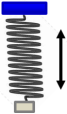
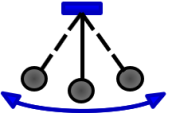
Figure 1. Oscillation.
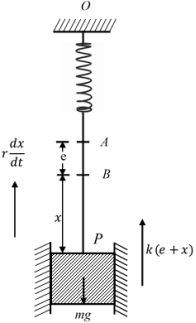
Figure 2. A suspended spring from fixed support.
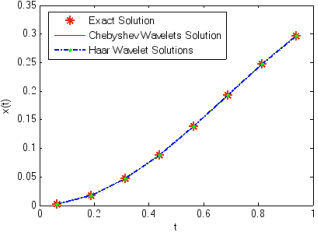
Figure 3. Comparison of analytical, Haar wavelet and Chebyshev wavelets solutions.
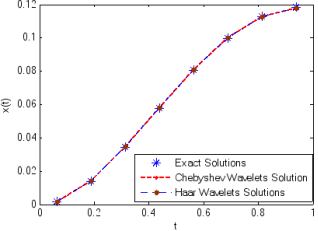
Figure 4. Comparison of Analytical, Haar wavelet and Chebyshev wavelets solutions.
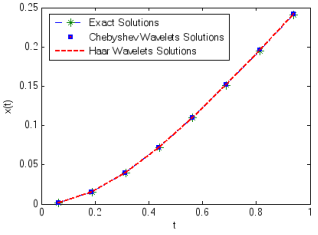
Figure 5. Comparison of Analytical, Haar wavelet and Chebyshev wavelets solutions.




 Share This Article
 Twitter
 Linked In
 Facebook
 Preeti is currently pursuing her PhD in Applied Mathematics and holds a Master’s degree in Mathematics. Her research primarily focuses on solving differential equations i.e. ordinary ae well as partial differential equations and integral equations using Chebyshev wavelets techniques. She has published five research papers in Scopus-indexed journals and one in an Web of Science-indexed journal. In addition, she has contributed two book chapter and published a research paper in peer-reviewed journal. Her work emphasizes the development of Chebyshev wavelets of different kinds for first order, second order and higher-dimensional models arising in applied sciences.
 Inderdeep Singh is an Associate Professor in the Department of Physical Sciences, Mathematics at Sant Baba Bhag Singh University, Jalandhar. He obtained his PhD in Mathematics from NIT Jalandhar and has published extensively in the field of differential equations i.e. ordinary and partial differential equations and computational methods. His research interests include numerical analysis, wavelet methods, semi-analytical methods, hybrid transform methods, fractional differential equations, and homotopy-based analytical techniques. Dr. Singh has been actively involved in international research collaborations and has contributed to various interdisciplinary applications. He has authored over 55 research articles in peer-reviewed journals and serves as a reviewer for several reputed international publications. Dr. Singh has also participated in numerous national and international conferences as a keynote speaker, technical committee member, and session chair. His work is widely recognized in the area of semi-analytical methods for solving higher-dimensional linear and nonlinear models.
 Copy
Copy Download