Research Article | | Peer-Reviewed

Analyses with Index Matrices Mathematical Models of Network Systems

Received: 17 November 2025     Accepted: 1 December 2025     Published: 26 December 2025
Views:       Downloads:
Abstract

The large amount of information nowadays requires building Data Centers and implementation of optimization models for storing and transferring data. The requirement of limited time of processing the network requests, are needed proper ways of redirection of data and application of algorithms programmatically in different levels. Before this, a data has to be gathered under different circumstances and to be checked if the information has been transferred successfully or not and then based on the results the counts of successful and not successful outcomes to presented and compared with predicate theory. There are many probability models, with which can be analyzed and predicted future events. In this article with the Theory of Index matrices, Graph theory and Theory of probabilities will be analyzed a stochastic process for modeling the times at which flows of a network enter a system. Because the network traffic depends on time, different scenarios of communication durations such as intrinsic time interval and endogenous jump time, will be considered and evaluated if they perform a certain condition. The most proper results of the experiments, which will be calculated with linear and exponential functions and represented with different Index matrices, can be used in machine learning of Data Center Networks.

Published in American Journal of Applied Mathematics (Volume 13, Issue 6)
DOI 10.11648/j.ajam.20251306.18
Page(s) 462-468
Creative Commons

This is an Open Access article, distributed under the terms of the Creative Commons Attribution 4.0 International License (http://creativecommons.org/licenses/by/4.0/), which permits unrestricted use, distribution and reproduction in any medium or format, provided the original work is properly cited.

Copyright

Copyright © The Author(s), 2025. Published by Science Publishing Group

Keywords

Index Matrices, Network Model, DCN, Fat-Tree Network Model, Probability Theory, Prediction, Poisson Process Model, Broadcast
1. Introduction
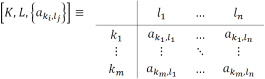
Let I be a fixed set of indices and be the set of the real numbers. Let the standard sets K and L satisfy the condition: K,LI. Let over these sets, the standard set-theoretical operations be defined. We call “IM with real number elements” (R-IM) the object:
,
where K=k1,k2,...,km and L=l1,l2,...,ln, and for 1im, and 1jn:aki,ljR.
When set R is changed with set {0, 1}, we obtain a particular case of an IM with elements being real numbers, that we denote by (0, 1)-IM.
When we choose to work with matrices, elements of which are logical variables, propositions or predicates – let us call these IM “Logical IMs (L-IMs)”.
Let the set of all used functions be Ƒ. The research over of this document.
IMs with function-type of elements has two cases:
1) each function of set Ƒ has one argument and it is exactly x (i.e., it is not possible that one of the functions has argument x and another function has argument y) – let us mark the set of these;
2) each function of set Ƒ has one argument, but that argument might be different for the different functions or the different functions of set Ƒ have different numbers of arguments.
2. Application of Probability Models in Network Systems
2.1. Probability Models
Theoretical mathematics is a key evolution factor of artificial intelligence (AI). Nowadays, representing a smart system as a mathematical model helps to analyze any system under development and supports different case studies. Scientists check and make researches with different models and methodologies objects of their research whether they meet certain criteria. Also, the analysis of data from a scientific experiment - be it a survey or laboratory measurement uses predicate logic. The core concept in probability theory is that of a probability model. The first component of a probability model is a sample space, which is a set whose elements are called outcomes or sample points. We will consider probability models only in the case where the sample space is finite. The second component of a probability model is a class of events, which can be considered for now simply as the class of all subsets of the sample space. The third component is a probability measure.
2.2. Distribution Function and Probability Space
Let us consider a space (Ω, F, P). For each outcome of a probability experiment, we assign a number, in other words, we set a function ξ=ξ(ω), which domain is Ω, and the set of values belongs to the set of real numbers. The values that ξ(ω) takes are random.
Let Ω be a space of elementary events. The function ξjj(ω) maps each point ω of Ω to a point xj = ξj(ω) on the number line, where 1≤jn.
A function ξjj(ω), defined on the space of elementary events Ω, is called a random variable if ξj-1(Ai) ϵF for every Borel set, where 1≤jn and 1≤im and.
A function F(xj) = Pj < xj), defined for every xjϵ, is called the distribution function of the random variable ξj. To each real number xj we assign the number F(xj), equal to the quantity of probability mass located to the left of xj, where 1≤jn.
2.3. Representation of z-images with Sequences of Discrete Values
Let the continuous function f(t) be given by its values flj = f(ljT), called discretes, at discrete times tj = ljT, where T is the discretization interval, where 1≤ j ≤ n.
We assume
z=esT ,(1)
where the z-image F(z) of the sequence f(ljT) for lj = 0, 1, 2, …, n is represented in the form
F(z) =l1f(ljT)z-lj,(2)
where 1≤ jn.
The correspondences between z-images and sequences of discrete values are written:
F(z) =ζ{f(ljT)},(3)
f(ljT)=ζ-1{F(z)},(4)
where 1≤ jn.
3. Representation of a Graph with an Index Matrix
Let a set of vertices U be given. Let's
E = {〈 uw, ur〉 |uw, urU}, where 1≤w≤|U|, 1≤r≤|U|.
Obviously, this is the set of all pairs of vertices of the set U.
Let H be an arbitrary subset of K. The ordered pair G = [U, H] is called "unoriented graph".
We will call a directed graph a graph which direction is determined for each of its edges. Formally, directed graphs are defined by
G* = [U, H*],
where U is the set of vertices of the graph and is the set of edges
H* ⊆ {〈 uw, ur〉 |uw, urU ∧ (〈 uw, ur〉 ∈ H* ∧ 〈 ur, uw〉 ∈ H* uw, ur〉 ≠〈 ur, uw〉), where 1≤w≤|U|, 1≤r≤|U|.
On every directed graph G* = [U, H*] a dimension matrix can be mapped |U| |U|, called an incidence matrix.
If the vertices of the graph are u1, u2, u3, …, un, where n = |U|, then we will ask that the w-th row and the r-th column correspond to a vertex uw.
Then (w,r), will correspond to the pair of vertices uw and ur will have value 1 if from vertex uw there is an edge to vertex ur, or value 0 otherwise.
Let a directed graph be given G = [U, H*]. Then its index incidence matrix will have the form (by analogy with the standard matrix of incidence)
IM(G) = [U, U, {auw,ur}],
where
auw,ur=1, oriented arc uw,ur H*0, otherwise,
where 1≤w≤|U|, 1≤r≤|U|.
4. Representation with Index Matrices Fat-Tree Network Model
We consider the set of all connected servers designed as directed weighted graph where weights equal the link capacities. The graph is denoted by G* = [U, H*], where U represents the set of nodes (i.e., Fat-Tree servers) and H* the set of links attaching each server to neighbors.
Then we can construct an index incidence matrix of Fat-Tree Network Model will have the form
IM(G) = [U, U, {auw,ur}],
where
auw,ur=1, oriented arc uw,ur H*0, otherwise
and 1≤ w ≤ |U|, 1≤ r ≤ |U|.
We denote the link from uw to ur as auw,ur  H*, 1≤ w ≤ |U|, 1≤ r ≤ |U|. We denote the residual bandwidth of the link auw,ur as Cwr(auw,ur) at the time instant Tlj, where 1≤ im, 1≤ w ≤ |U|, 1≤ r ≤ |U|.
4.1. Centralized Multicast path Computation within Fat-Tree DCN
In this proposal, we consider Constant Bit Rate (CBR) flows. Let with the index set Q = {q1, q2, … q5} define different arrival times of packets. Let with the index set E = {e1 = 6, e2 = 12, e3 = 18, e4 = 24, e5 = 30} define flows requests with a fixed band width. Let be defined a Poisson process with velocities λ1 = 6 per second and λ2 = 3 flows per 2 seconds.
Then can be calculated times duration of a Poisson process with a velocity λ1 = 6 per second of transmitting of each flow with formula
qi=eiλf,(5)
where 1≤i≤5 and substituting with the values of the elements of the index set E of flows with different band width, we can assign q1 =eiλ1 = 66=1, q2 = 126=2, q3 = 186=3, q4 = 246=4, q5 = 306=5. Because the max value of the arrival times of packets is q5 and the duration of transmitting each flow is 1 second, then with the index set Y = {y1 =1, y2 =2, y3 =3, y4 =4, y5 =5} will define times duration of transmitting of each flow. Let with the index L = {l1 =1, l2 =2, l3 =3, l4 =4, l5 =5} denote intervals of 5 units, where each unit is calculated by the function Z(yj) = lj = yj*6, where 1 ≤ j ≤ 5. Because the elements of the index set L are intervals, we can assign the index set to a probability measure.
Then Z(yj) has only a finite or countable number of possible sample values, say y1, y2, y3, y4, y5 the probability Zj { Zj (yj) = yi} of each sample value yi is called the probability mass function at yi and denoted by pZ(Yi); such a random variable is called discrete for 1≤in. The ‘staircase function,’ (the CDF of a discrete random variable) is having a jump of magnitude pZ(yi) at each sample value yi and stays constant between the possible sample values for 1≤in. As a result, the discrete random variables can be specified by the probability mass function and the cumulative distribution function.
Because the velocity of a Poisson process is assigned to λ1 = 6 per second, then we can define the derivative(probability density) of Y at yi as the time duration of transmitting each flow and denoted by Z(yj); for δ>0 sufficiently small if there is a function Z(yj) δ, such that for each yiR, that defines the existence of a cumulative distribution function satisfies -|Y|Z(yi)d(yi-1-yi), where 1 ≤ i ≤ |Y-1|.
There are 5 complete results of the experiment to be modeled, so we can define 5 outcomes or sample points in a probability model.
The possible outcomes (the space of possible results) are 1, 2, 3, 4 or 5 that are mutually exclusive and collectively constitute. In order to define the finest grain result of the probability outcome, will define singleton event ω that contains no proper subsets.
With the restriction to the max value of elements of the index set L, we can assign to non-negative value to each outcome. Then, let with the index set K = {k1 = “F(x1)≤6”, k2 = “F(x2)≤12”, k3 = “F(x3)≤18”, k4 = “F(x4)≤24”, k5 = “F(x5)≤30”} denote predicates.
Then, according to the definition that a random variable (rv), we can assign the function Fki(ylj) as a function Z from the sample space Ω of a probability model to the set of real numbers R, where 1≤i≤5, 1≤j≤5. First, Fki(ylj) might be undefined or infinite for a subset of Ω that has 0 probability, where where 1≤i≤5, 1≤j≤5. Second, the mapping Zki (ωki) must have the property that {ω∈ Ω: Fki(ylj) ≤ ei} is an event for each kiR, where where 1≤i≤5, 1≤j≤5. Third, every finite set of random variables Fk1,..., Fk5 has the property that for each ylj1R,..., yl5R,{ ω: Fk1(ω) ≤ e1,..., Fk5 (ω) ≤ e5} is an event.
Then we can construct an Index matrix A=[K, L, {aki,lj}] of probability trials, where ak1,l1 = 1, ak1,l2 = 0, ak1,l3= 0, ak1,l4= 0, ak1,l5 = 0, ak2,l1= 1, ak2,l2= 1, ak2,l3 = 0, ak2,l4 = 0, ak2,l5 = 0, ak3,l1= 1, ak3,l2 = 1, ak3,l3= 1, ak3,l4= 0, ak3,l5 = 0, ak4,l1= 1, ak4,l2 = 1, ak4,l3 = 1, ak4,l4 = 1, ak4,l5 = 0, ak5,l1= 1, ak5,l2= 1, ak5,l3 = 1, ak5,l4= 1, ak5,l5= 1 and 1≤i≤5, 1≤j≤5.
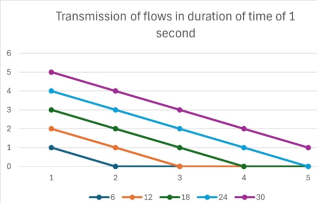
In Figure 1 is illustrated the transmission of flows in time.
Figure 1. Transition of flows in time.
With the elements of the index set L, we illustrate that we performing exactly 5 trials of the same experiment (i.e., repeat the same idealized experiment exactly 5 times). With the these 5-tuples of sample points, will be calculated the probabilities of each outcome and the prediction of occurrence of an event in the future. The results are important to make decision for the state of a machine. In is given an example of fault detection in machine using the programme product of index matrices.
The Cartesian product is the sample space of the 5-repetition model.
Ω<sup></sup>|K|= {(ωk1, ωk2,ωk3,ωk4,ωk5):ωki∈Ω for eachi, 1≤i≤5},(6)
i.e., the set of all 5-tuples for which each of the 5 components of the 5-tuple is an element of the original sample space Ω. Since each sample point in the 5-repetition model is an 5-tuple of points from the original Ω, it follows that an event in the n-repetition model is a subset of Ω<sup></sup>|K|, i.e., a collection of 5-tuples (ωk1, ωk2, ωk3, ωk4, ωk5), where each wkiis a sample point 5 from Ω, where 1≤i≤5. This class of events in Ω<sup></sup>|K| should include each event of the form {(Ak1, Ak2, Ak3, Ak4, Ak5)}, where {(Ak1, Ak2, Ak3, Ak4, Ak5)} denotes the collection of 5-tuples (ωk1, ωk2, ωk3, ωk4, ωk5) where ωkiAkifor 1≤i≤5. The set of events (for 5-repetitions) must also be extended to be closed under complementation and countable unions and intersections.
In order to create the probability model in the experiment, there are defined 5-trials that are statistically independent. Moreover, we assume that for each extended event {(Ak1Ak2Ak3Ak4Ak5)} contained in Ω<sup></sup>|5|, we have
P{(Ak1Ak2Ak3Ak4Ak5)} =ki=15Pki{Aki} ,(7)
where Pki{Aki} is the probability of event Aki in the original model for 1≤i≤5. Each events in each trial are independent of those of any other trials of the extended independent 5-repetition model. From Figure 1, we can see that the element k1 of the index set K and element l1 of the index set L satisfies the first condition, and for the other indexes of the index set K of columns and the index set L of rows in progressive order, the count of elements that satisfies the conditions are growing in linearly, so we can conclude that for less time less flows will be transmitted. Let with the index set 0 < S1 < S2 < S3 < S4 < S5 the sequence of increasing random variables that represent an arrival process.
Definition 3. A renewal process is an arrival process for which the sequence of interarrival times is a sequence of IID random variables.
Definition 4. A Poisson process is a renewal process in which the interarrival intervals have an exponential distribution function; i.e., for some real λ> 0, eachXkihas the density
fX(x) = λexp(-λxi)(8)
for xi ≥0 and for 1≤i≤5.
The parameter λ1 is called the rate of the process. We shall see later that for any interval of size t, λi is the expected number of arrivals in that interval. Thus is called the arrival rate of the process.
Analogically, can be calculated times duration a Poisson process with a velocity λ2 = 3 per 2 seconds of transmitting of each flow with formula (1), where 1≤i≤5 and substituting with the values of the elements of the index set E of flows with different band width, we can assign q1 =eiλ1 = 63=2, q2 = 123=4, q3 = 183=6, q4 = 243=8, q5 = 303=10. Because the max value of the arrival times of packets is q5 and the duration of transmitting each flow is 2 seconds, then the max duration of transmitting each flow will be q52 with the index set X = {x1 =1, x2 =2, x3 =3, x4 =4, x5 =5, x6 =6, x7 =7, x8 =8, x9 =9, x10 =10} will define times duration of transmitting of each flow. Let with the index V = {v1 =2, v2 =4, v3 =6, v4 =8, v5 =10, v6 =12} denote intervals of 6 units, where each unit is calculated by the function F(xj) = lj = xj*3, where 1 ≤ j ≤ 6.
Let with the index set Y = {y1 = “F(x1)≤6”, y2 = “F(x2)≤12”, y3 = “F(x3)≤18”} denote predicates.
Then we can construct an Index matrix B=[Y, V, {byi,vj}] of probability trials, where by1,v1 = 1, by1,v2 = 0, by1,v3 = 0, by1,v4 = 0, by1,v5 = 0, by1,v6 = 0, by2,v1 = 1, by2,v2 = 1, by2,v3 = 0, by2,v4 = 1, by2,v5 = 0, by2,v6 = 0, by3,v1 = 1, by3,v2 = 1, by3,v3 = 1, by3,v4= 0, by3,v5 = 0, by3,v6 = 0 and 1 ≤ i≤ 3, 1 ≤ j ≤ 6
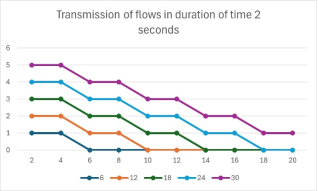
In Figure 2 is illustrated the transmission of flows in time.
Figure 2. Transition of flows in time.
For the two experiments, we have given bigger value of the velocities to less value of time for transmitting flows from one node to another in a network system, and we can conclude that for less value of λ, requires more time for transmitting flows from one node to another in a network system.
Each flow Fki requests a fixed band width equals to
Bki,lj=VkiTlj,(9)
where the volume of transferred bits is denoted by Vki, then we can calculate each band width for a each flow, 1≤ im, 1≤ jn. It follows a random uniform distribution within duration denoted by Tlj interval which follows the random exponential distribution, 1≤ jn. We model the arrival rate of Fki as a Poisson process with density λf, 1≤ im.
In order to maximize the QoS satisfaction in the network, our objective is to calculate the optimal multicast tree for each Fki by allocating the requested bandwidth, where 1≤ im. Then, the SDN controller exploits i) our optimization algorithm (SDN application) proposal and ii) OpenFlow rules to respectively calculate and install the multicast routing tree within Fat-Tree DCN.
To be more specific, for flow Fki from source uw to the set of destinations D, we search for a multicast tree that maximizes the residual bandwidth with the fewest possible number of links, 1≤ im, 1≤ w ≤ |U|. Then, we consider the binary variable xuw,ur equals to 1 when the link auw,ur is selected for the tree path allocation and equals to 0 otherwise, where 1≤ w ≤ |U|, 1≤ r ≤ |U|.
We denote yuw,ur as an auxiliary variable quantifying the residual capacity of the link, expressed as:
yuw,ur =Cwr(auw,ur)-Bki.xuw,ur(10)
where Cwr(auw,ur) should be greater than the requested bandwidth Bpr and represents the capacity of all links auw,ur. Note that only links auw,ur with sufficient capacity Cwr(auw,ur) in terms of bandwidth can be considered to build the multicast routing tree in the system, where 1≤ w ≤ |U|, 1≤ r ≤ |U|.
4.2. Representation of the Non-stationary Poisson Process Model with a Fuzzy Index Matrix
Suppose that the network system consists of n nodes, which will be indexed as uw = 1,..., |U| the rest of this paper. Let with the index set K = {k1 = 1, k2 = 2, k3 =3, k4 = 4, k5 = 5} denote number of nodes of the network system. Let with the index set L = {l1 = 1, l2 = 2, l3 = 3} denote a time interval in seconds. The arriving flow Fki(t) of the uw-th node at the lj-th time interval is assumed to behave as a non-stationary Poisson process
P (Fki(tlj)) =e-λki(tlj)λki(tlj)|U| |U|!(11)
where, P denotes the abbreviation of the probability.
Moreover, the varying process of the arriving rates λki(tl1) = 9, λki(tl2) = 6, λki(tl3) = 3 are assumed to change according to a network wide finite-state deterministic or stochastic process, where 1≤ i ≤ 5. The system will enter one state during a certain time interval τ and then enter another state, which as a result changes the arriving rate as well as the arriving flux of the Poisson process.
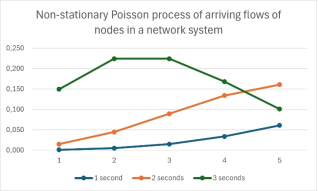
Also, we can construct a Fuzzy Index matrix of values of probabilities of a transient process of flows requests with a fixed band width C=K,L,cki,lj, where ck1,l1 = 0.001,0.999, ck1,l2 = 0.015,0.985, ck1,l3 = 0.149,0.851, ck2,l1 = 0.005,0.995, ck2,l2 = 0.045,0.955, ck2,l3 = 0.224,0.776, ck3,l1 = 0.015,0.985, ck3,l2 = 0.089,0.911, ck3,l3 = 0.224,0.776, ck4,l1 = 0.034,0.966, ck4,l2 = 0.134,0.866, ck4,l3 = 0.168,0.832, ck5,l1 = 0.061,0.939, ck5,l2 = 0.161,0.839, ck5,l3 = 0.101,0.899,
where the elements
cki,lj=μki,lj,1-μki,lj are fuzzy pairs, where μk1,lj+1-μk1,lj≤ 1 and
μki,ljis calculated with the formula: Fki(zlj) = e-λki(tlj)λki(tlj)|U| |U|!, where 1≤ i ≤ 5, 1≤ j ≤ 3.
In Figure 3 is illustrated non-stationary Poisson process of arriving flows of nodes in a network system in duration of 1 second, 2 seconds and 3 seconds.
Figure 3. Non-stationary Poisson process of arriving flows of nodes in a network system.
5. Conclusions
In this article the authors analyze with Index matrices atraffic in network with different scenarios in duration of time and number of flows the load in the Poisson distribution of the network. Moreover, with the non-stationary Poisson process model, represented with Fuzzy Index matrices, can be predicted the probabilities of a transmission of flows in nodes of a network system. As a result, the obtained data from the calculations according to different variants of cases can be programmatically implemented in machine learning of DCN.
Abbreviations

IM

Index Matrix

L-IM

Logical IM

DCN

Data Center Network

Author Contributions
Stela Todorova: Formal Analysis, Data curation, Methodology
Ivan Ivanov: Conceptualization, Investigation, Resources
Data Availability Statement
The data supporting the outcome of this research work has been reported in this manuscript.
Conflicts of Interest
The authors declare no conflicts of interest.
References
[1] Atanassov, K. Index Matrices: Towards an Augmented Matrix Calculus. Springer, Cham (2014).
[2] Todorova, S. Overview of publications on index matrices. (2022-2023) Yearbook of Section "Informatics". Union of Scientists in Bulgaria. pp. 32-62. Tom XII (Volume XII).
[3] Atanassov, K. Bureva V. Short course on discrete structures. Avangard Prima. Sofia. 2018.
[4] Roua Touihri. optimizing routing and resource allocation in sdn-based server only data center networks for private cloud architectures. Hardware Architecture [cs.AR]. Université Paris-Est, 2021. English. NNT: 2021PESC0061.
[5] Todorova, S. Research of the index matrices and their applications. University "Prof. A. Zlatarov" (AU). Faculty of Technical Sciences. Academic degree: Doctor (PhD). 30.09.2024. Supervisor: Assoc. Prof. Veselina Kuncheva Bureva, PhD; Assoc. Prof. Nora Angelova Angelova, PhD. Reviewers: Acad. Prof. Krassimir Todorov Atanassov, DSc DSc Assoc. Prof. Velin Stoqanov Andonov, PhD. Burgas. 113 pages.
[6] Robert G. Gallager. Stochastic Processes: Theory for Applications. Cambridge University Press. Kindle Edition. 2013.
[7] Yu-Dong, C., Li, L., Yi, Z., & Jian-Ming, H. Fluctuations and pseudo long range dependence in network flows: a non-stationary Poisson process model. Chinese Physics B, 18(4), 1373. 2009.
[8] El, Fawal, A. H., Mansour, A., & Nasser, A. Markov-Modulated Poisson Process Modeling for Machine-to-Machine Heterogeneous Traffic. Applied Sciences, 14(18), 8561. 2024.
[9] Todorova, S. Representation with Index Matrices Discrete Random Variables. Am J Appl Math. 13(1): 57-63.2025.
[10] Farhi, S. Nenov, G. Kuyumdzhiev, T. Practical circuits with switched capacitors (SC - circuits). State Publishing House "Technika". Sofia. 1987.
[11] Todorova, S Analysis of Charging and Discharging of Capacitor with Fuzzy Index Matrices. Applied Matrix Theory and Principal Component Analysis in the Digital Era [Working Title]. IntechOpen. 2025. Available at:
[12] Todorova, S. Autoreferat of Research of the index matrices and their applications. University "Prof. A. Zlatarov" (AU). Faculty of Technical Sciences. Academic degree: Doctor (PhD). 30.09.2024. Supervisor: Assoc. Prof. Veselina Kuncheva Bureva, PhD; Assoc. Prof. Nora Angelova Angelova, PhD. Reviewers: Acad. Prof. Krassimir Todorov Atanassov, DSc DSc Assoc. Prof. Velin Stoqanov Andonov, PhD. Burgas. 113 pages.
[13] Todorova, S. Representation with an Index Matrix, Which Elements are Derivative Functions, Values Read by Arduino Uno and Photoresistor. Tenth Conference on Lighting (Lighting). Sozopol. Bulgaria. 2025, pp. 1-5,
[14] Todorova S., Bureva V. Angelova N. Proykov M. Programme Product for Index Matrices. Book of Abstracts of International Symposium on Bioinformatics and Biomedicine 8-10 October 2020, Burgas, Bulgaria. 2020.
[15] S. Todorova. Method of predicate calculus applying a membership classification rule to create an indexed matrix of belonging. Electronic scientific journal Scientific Atlas. 2021.
Cite This Article
  • APA Style

    Todorova, S., Ivanov, I. (2025). Analyses with Index Matrices Mathematical Models of Network Systems. American Journal of Applied Mathematics, 13(6), 462-468. https://doi.org/10.11648/j.ajam.20251306.18

    Copy | Download

    ACS Style

    Todorova, S.; Ivanov, I. Analyses with Index Matrices Mathematical Models of Network Systems. Am. J. Appl. Math. 2025, 13(6), 462-468. doi: 10.11648/j.ajam.20251306.18

    Copy | Download

    AMA Style

    Todorova S, Ivanov I. Analyses with Index Matrices Mathematical Models of Network Systems. Am J Appl Math. 2025;13(6):462-468. doi: 10.11648/j.ajam.20251306.18

    Copy | Download

  • @article{10.11648/j.ajam.20251306.18,
      author = {Stela Todorova and Ivan Ivanov},
      title = {Analyses with Index Matrices Mathematical Models of Network Systems},
      journal = {American Journal of Applied Mathematics},
      volume = {13},
      number = {6},
      pages = {462-468},
      doi = {10.11648/j.ajam.20251306.18},
      url = {https://doi.org/10.11648/j.ajam.20251306.18},
      eprint = {https://article.sciencepublishinggroup.com/pdf/10.11648.j.ajam.20251306.18},
      abstract = {The large amount of information nowadays requires building Data Centers and implementation of optimization models for storing and transferring data. The requirement of limited time of processing the network requests, are needed proper ways of redirection of data and application of algorithms programmatically in different levels. Before this, a data has to be gathered under different circumstances and to be checked if the information has been transferred successfully or not and then based on the results the counts of successful and not successful outcomes to presented and compared with predicate theory. There are many probability models, with which can be analyzed and predicted future events. In this article with the Theory of Index matrices, Graph theory and Theory of probabilities will be analyzed a stochastic process for modeling the times at which flows of a network enter a system. Because the network traffic depends on time, different scenarios of communication durations such as intrinsic time interval and endogenous jump time, will be considered and evaluated if they perform a certain condition. The most proper results of the experiments, which will be calculated with linear and exponential functions and represented with different Index matrices, can be used in machine learning of Data Center Networks.},
     year = {2025}
    }
    

    Copy | Download

  • TY  - JOUR
    T1  - Analyses with Index Matrices Mathematical Models of Network Systems
    AU  - Stela Todorova
    AU  - Ivan Ivanov
    Y1  - 2025/12/26
    PY  - 2025
    N1  - https://doi.org/10.11648/j.ajam.20251306.18
    DO  - 10.11648/j.ajam.20251306.18
    T2  - American Journal of Applied Mathematics
    JF  - American Journal of Applied Mathematics
    JO  - American Journal of Applied Mathematics
    SP  - 462
    EP  - 468
    PB  - Science Publishing Group
    SN  - 2330-006X
    UR  - https://doi.org/10.11648/j.ajam.20251306.18
    AB  - The large amount of information nowadays requires building Data Centers and implementation of optimization models for storing and transferring data. The requirement of limited time of processing the network requests, are needed proper ways of redirection of data and application of algorithms programmatically in different levels. Before this, a data has to be gathered under different circumstances and to be checked if the information has been transferred successfully or not and then based on the results the counts of successful and not successful outcomes to presented and compared with predicate theory. There are many probability models, with which can be analyzed and predicted future events. In this article with the Theory of Index matrices, Graph theory and Theory of probabilities will be analyzed a stochastic process for modeling the times at which flows of a network enter a system. Because the network traffic depends on time, different scenarios of communication durations such as intrinsic time interval and endogenous jump time, will be considered and evaluated if they perform a certain condition. The most proper results of the experiments, which will be calculated with linear and exponential functions and represented with different Index matrices, can be used in machine learning of Data Center Networks.
    VL  - 13
    IS  - 6
    ER  - 

    Copy | Download

Author Information
  • Department of Mathematics, Informatics and Physics, Burgas State University “Prof. Dr. Assen Zlatarov”, Burgas, Bulgaria

    Biography: Stela Todorova is a Doctor of Technical sciences graduated at the University "Prof. Dr. Asen Zlatarov", Department “CST”, Faculty of Technical Sciences with the topic of her dissertation "Research of the index matrices and their applications". She graduated High School of Natural Sciences and Mathematics “Acad. Nikola Obreshkov”, Bachelor's degree in Informatics and Computer Science and Master's degree in Information Security at BFU, Burgas. Her current research interests are in the field of index matrices, intuitionistic fuzzy sets and etc.

    Research Fields: Index Matrices, Fuzzy logic

  • Faculty of Technicks and Technologies, Trakia University, Stara Zagora, Bulgaria

    Biography: Ivan Ivanov is a doctoral student at Trakia University – Faculty of Engineering and Technology, Department of Electrical Engineering, Electronics and Automation. His dissertation is on the topic of “Optimization of packets in the control plane of SDN networks using machine learning”. He holds a Master’s degree in Precision Mechanical Engineering and Instrumentation from the Technical University – Gabrovo (2000) and a Master’s degree in Automation and Computer Systems from the Faculty of Technicks and Technologies - Yambol (2016). He has participated in international scientific conferences, and his research interests are focused on analysis and optimization of SDN network protocols and application of machine learning for network traffic management.

    Research Fields: analysis and optimization of SDN network protocols, application of machine learning for network traffic management